
Soil Temperature & Moisture
Soil Temperature Information
NDAWN has three types of soil sensors:
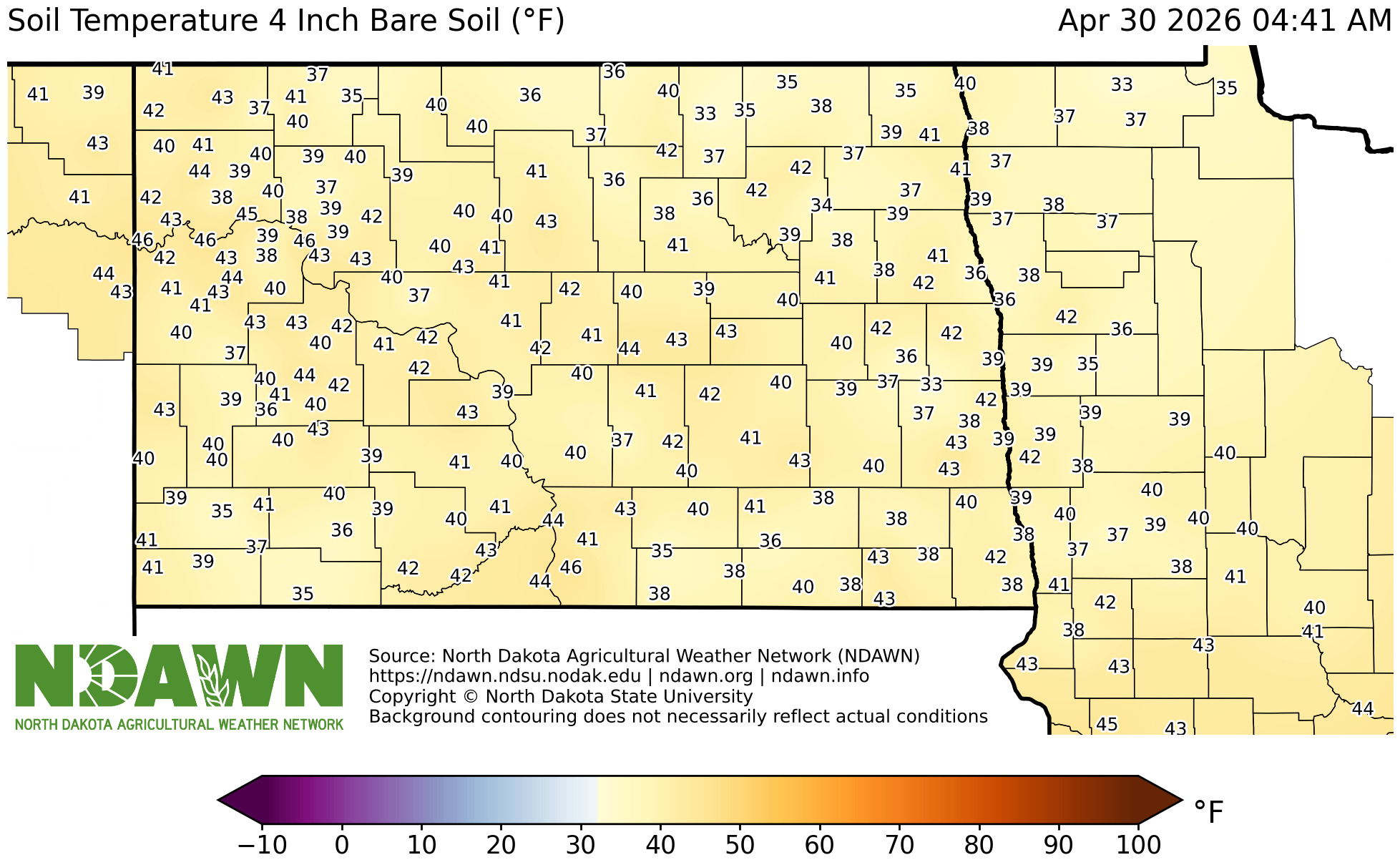
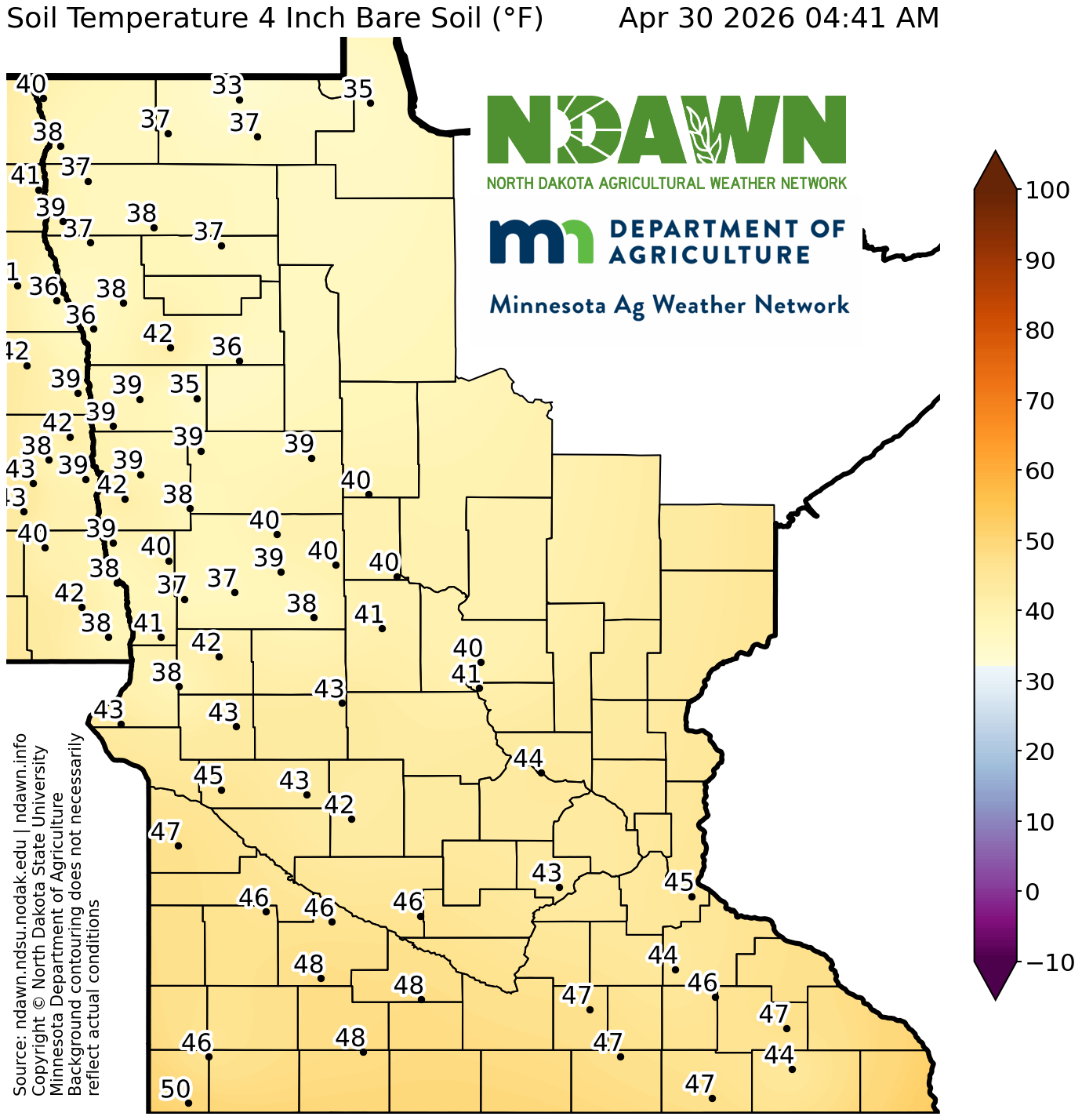
- Bare/Turf Soil: measures temperature at 4" depth beneath bare ground or turf cover with either thermocouples or thermistors, typically to the south of the station
- CS655 Soil Sensors: measures temperature and volumetric water content with CS655 soil probes at depths of 2", 4", 8", 20", and 40" beneath turf cover, typically to the northwest of the station
- Deep Soil Probe: measures temperature with thermocouples at 14 depths from 5cm to 225cm beneath turf cover, typically to the northeast of the station
Temperatures at similar depths may vary between the three sensors due to varying sensor types and location of installation. Although we aim to have uniformity in station installation, variations are inevitable. Vegetation type and height, soil moisture, and snow cover all impact the temperature profile of the soil and can vary around the station. During the spring thaw and winter freeze-up the differences are most pronounced as snow, ice, standing water, and thawed ground all occur in near proximity to each other. Newer stations are also more prone to discrepancies in soil data until a uniform vegetative cover is established.
Understanding soil water content helps determine how much water is available for crops and when irrigation is needed. Soil is a three-phase system made up of air, water, and solids. Each soil has a particular Volumetric Water Content (VWC) at Field Capacity (FC) and Permanent Wilting Point (PWP), where:
- VWC: Volume of water divided by the combined volume of air, water, and solids.
- FC: Water a soil holds after excess has drained.
- PWP: Point where plants can no longer extract water.
NDAWN stations use hourly VWC data, as measured by CS655 soil probes, to indicate soil water status by comparing VWC to threshold values of FC and PWP to identify whether conditions are too dry (deficit), approaching dry (short), sufficient (optimal), or saturated (surplus):
- Deficit: VWC is less than the PWP. Plants cannot extract water from the soil.
- Short: VWC is between PWP and FC, but plant available water is running low.
- Optimal: VWC is between PWP and FC. Soil contains plant available water.
- Surplus: VWC is above the FC. Soil is saturated.
The set values for FC and PWP at each location are site specific and depend on soil type. FC and PWP are derived from field data, lab analysis, or long-term VWC observations